
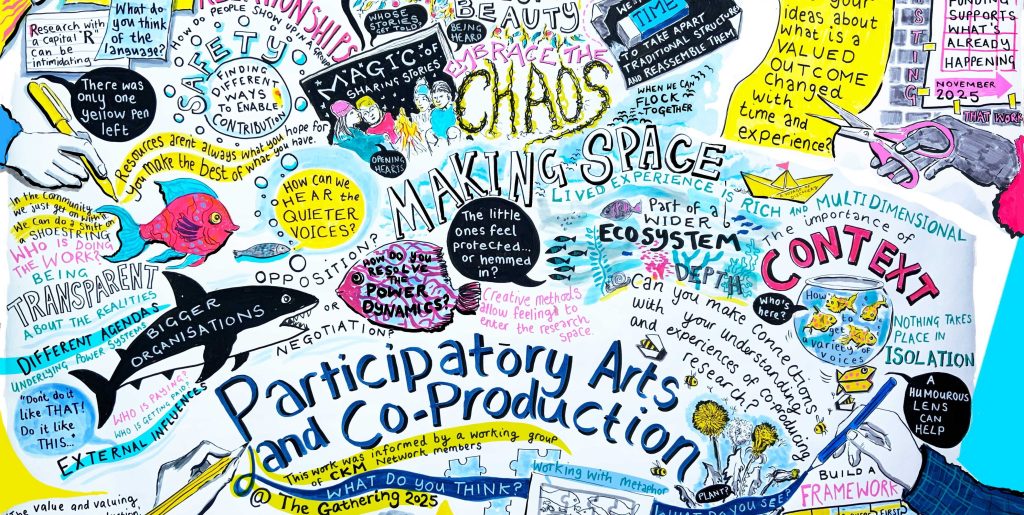
A blog from our PhD Researcher, Helen Berry. This post is based on an eight month long collaboration between Helen and Community Knowledge Matters, a Scottish network bringing together people and organisations interested in community-led research. Intersecting with the network’s interests and values, this work was part of Helen’s doctoral research exploring how people and organisations give meanings and value to co-producing research in Scotland.
This small project aimed to meaningfully engage members of the Community Knowledge Matters network – tilted towards community members and grassroots organisations – in the research, through a creative workshop as part of the network’s national, in-person event. The workshop explored the intersections between creativity, research and co-production. The workshop was co-created through a longer process (rather than ‘delivered’) in order to respect and service the network’s values, including collaboration, respect and integrity.
The blog has been assembled by Helen in conversation with multiple voices: Lewis Hou (Director of Science Ceilidh, host organisation of Community Knowledge Matters); Sophie Kendrick (Project Officer of Science Ceilidh); Jenny Capon (Visual artist); Màiri Morrison (of Comann Eachdraidh Uibhist a Tuath, North Uist Historical Society and member of Community Knowledge Matters); Charlotte Mountford (Director of Lyth Arts Centre and member of Community Knowledge Matters); Mary Ann Ferguson (Public and Community Engagement Officer of Muir is Tir and member of Community Knowledge Matters); Karen Mohan (of Centred and member of Community Knowledge Matters.)
The purpose of this blog is to share the visual research outputs of this fruitful collaboration with a wider audience, and provide a container for the reflections of some of those closely involved. All illustrations featured in this blog are drawn by Jenny Capon.
Background to our collaboration
Our work together took the form of ongoing dialogue with Science Ceilidh and a small working group drawn from the Community Knowledge Matters network – to shape a creative, pre-conference workshop, nested within the network’s Gathering of 2025 (held 10-11th November 2025 in Inverness). The workshop was facilitated by Helen and recorded by visual artist Jenny Capon, with a diverse group of 17 taking part.
The workshop was bookended with working group meetings to refine the themes, questions, method and tone, and provide space and time for collective reflection post hoc. The overall theme of the workshop was how co-producing research comes to be valued, or otherwise, particularly from community and grassroots perspectives.
The purpose of the extended collaboration was to move beyond a researcher-led model of ‘gathering data’, by having a series of transparent conversations about how the work could fulfil our intersecting interests while respecting the network’s capacity; and what mutual benefit might look like for us. Early discussions led to the ideas of commissioning a community artwork to document the workshop, supported by my research funding as an in-kind contribution to the network, and convening a working group to position the one-off workshop within a longer-term, generative process. The community artwork, we conceived, could benefit the network and its members and be punctually available, signalling shared benefit and ownership of knowledge.
For my research, the collaboration afforded a unique opportunity to work with community members, academics working with communities, and community organisations, with a strong focus on rural and island Scotland. Practically, our wider process provided: reassurance that the workshop themes and methods would be resonant and relevant for those participating; space and time to further explore what was being learned; and the kind of embodied knowledge that helps me as a researcher to understand how to show up in a particular group. Ethically and strategically, working in this way with Community Knowledge Matters reflects our shared interests and values in disrupting the norms of academic practice and in research futures that are more genuinely collaborative.
Pushing cultures of knowledge production
Co-production has multiple meanings, values and intents; however, it is often considered from singular directions. This tension is embodied in my research itself, which tries to contain a study of collaborative knowledge within a traditional, academic knowledge frame. The PhD form infers academic norms and requirements that may not be of interest or value to other knowledge communities. Others have written about the points of tension between the PhD (doctoral) research model and participatory research, including issues of time and sequencing, competing priorities, remuneration, individualism within academia, and requirements of sole authorship (Lambley, 2025; Southby, 2017). I have reflected on the distribution of benefit and burden in academic research with communities, and how these considerations extend to partnering organisations, as well as individual contributors.
My collaboration with Community Knowledge Matters was an attempt to work mindfully and transparently with the tensions described. Following the experiences of other doctoral researchers pursuing participatory values (Klocker, 2012), I have used a dual outputs approach here, so while there will be an academic thesis, there is also a set of artworks to share more immediately with the network and its members, and in a knowledge form that may be more suited to their needs. The original artwork has been gifted to Community Knowledge Matters. I am mindful that it is only with the financial support of The Binks Hub that reciprocity in the research relationship could be achieved in this way. Many student researchers would not share in this privilege.
As well as considering the output however, the collaborative process shaped the questions being asked, and also how they were asked (method), thereby moulding the knowledge to be brought into being – to be more collaborative and mutually valued.
Presenting our artwork and reflections
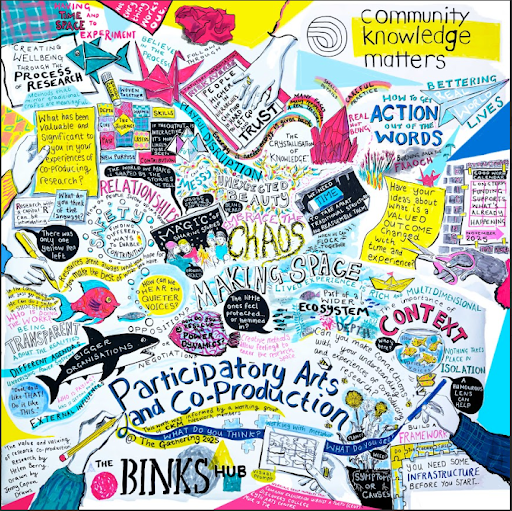
One purpose of this blog is to share the visual research outputs of this fruitful collaboration with a wider audience, and provide a container for the reflections of some of those closely involved. This piece is therefore written with many voices, expressed through both textual and visual content, reflecting co-production in general, as well as in relationship to this work. With the context of the collaboration set out, I now offer a selection of artworks and collective reflections on our process and product.
Reflecting on our process
Visual artist Jenny reflects on the significance of process and creativity to co-producing research – and to our communal reflection on co-producing research:
For me this workshop shone a light on the value of creativity in community research as a formative process in itself. Not just for the experiences shared, actions and outcomes generated, but how the way those are facilitated can impact both the dynamics of a group conversation, and the quality and richness of what emerges. Through creative engagement new connections are made and relationships are formed as individuals’ creative outcomes are warmly supported and discussed.
Creativity brings lightness and a certain freedom from boundaries to the way people express themselves.
Sophie reflected thoughtfully on her own creative experience, and how a creative invitation can bring forward rich responses:
… every explanation of the artwork I heard involved considerable nuance, suggesting to me that co-production is, of course, a complicated and layered process that takes time to execute well. I resonated with this complex yet hopeful understanding of co-production.
Looking across the collaboration, Lewis contemplates the significance of process, relational working, and trust to creating the shared space where knowledge can be kindled:
This has been an important process. It is literally part of the infrastructure itself, building on existing relationships whilst developing something entirely new together from that foundation. What has been truly important is the sense of trust and knowing where we are all coming from; that always brings a welcome sense of familiarity into workshops where we are asking people to be vulnerable, to take risks, to be open. I never tire of hearing everyone’s stories, and I don’t think that would have happened without the co-production working group we had beforehand.
Mary Ann enjoyed meeting people with different experiences through the collaboration, and agrees with Lewis that the wider process was foundational to the workshop itself, building confidence in “a new way of expression”. Charlotte feels we created “a really reflective space”. Similarly, Màiri describes the process as inclusive, exciting and useful, reflecting eloquently on the nuances of the research themes and her experiences – suggesting that complex questions warrant a processual and considered approach to inquiry:
Making values visible, how best to convey these, seem difficult areas to articulate. Trying to describe the non-colonising, mutually beneficial processes involved in making research together and finding the time and ways to let this happen naturally, organically, has not always been easy.
Echoing the sense that this work and its value are difficult to articulate, Charlotte feels better able to account for it, following this work together and highlighting the importance of communal reflection:
I feel way more confident in describing the participatory work we do as research and feel like this process has given me a better sense of its value and how to speak about that.
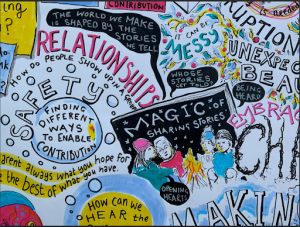
Jenny also considers how method – the way we make meanings together – can unsettle (not resolve) power differences, and bring forward a different kind of knowledge. The use of language she describes as “passionate” and “poetic” is loose and figurative, challenging to interpret but perhaps more resonant with our lived experiences. And providing space for criticality, doubt, and tentative feelings, that a reliance on verbal communication alone might miss. A visual example is provided below Jenny’s words, where the world-making power of stories and storytelling is juxtaposed with the realities of relational working:
Discomfit enters the room too. Experts, confident in their respective fields can be faced with a process which is unfamiliar. And the process of creating – to play, in this instance, with pictures and words, can take us back to the openness and freedom of childhood.
To be a beginner again, a learner, perhaps can be an equaliser, making everyone a better listener, a supportive group member, a poetic and passionate speaker.
Reflecting on our outputs
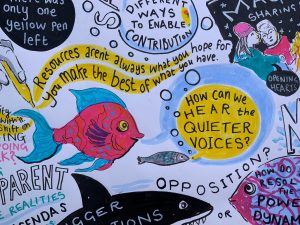
On the artwork itself, Lewis reflects on the richness of the piece, highlighting implicitly the value of visuals in reverberating with and clarifying our learning, stories, and experiences. Lewis’ contribution alludes to the importance of knowledge systems and infrastructures; a perspective currently drawing attention across the field. This systemic orientation is extended in the section of the artwork shown below, with reference to resources – or lack thereof (“there was only one yellow pen left”):
I feel the piece reflects the reality of co-production well. Much of this resonates with the learning we’ve had as part of the Community Knowledge Matters network, from the serious elements around identifying power to the sense of joy, beauty, and even the slight “cheekiness” that is so vital to this kind of relational work. I particularly like the point about “doing the corners first” and how it highlights the importance of infrastructure – whether the canvas or the spaces and places we convene around.
Like Lewis, Màiri was drawn to the multiplicity and messiness of the visual imagery, creating space and opening up new ways of looking:
For a not very visual person it seems a jigsaw of possibilities, reflected in the placing of colours, attractive lettering and the appealing density of the patterning of texts/headings. Its riffs forced my mind into exploring responses/ reflections and trying to forge connections in a playful way.
Mary Ann honed in on the visual motif of hands featuring in the artwork, symbolising the role of different people’s ideas in community knowledge:
I was looking at the hands adding to the artwork. I had lots of thoughts about … Give me your hand, and sayings like, the hand that feeds, lets join hands, and their meanings. I thought that it was important to show the hands adding to the drawing or feeding the drawing with thought-provoking designs.
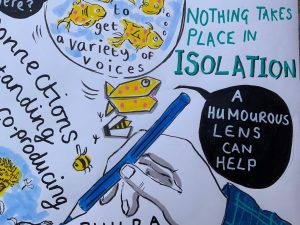
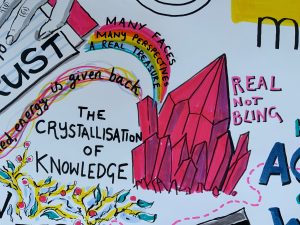
To end with Jenny’s words, in both the co-production of research and this particular collective conversation, we were and are (because the conversation does not end …), “all in the same metaphorical boat, shaping ideas with scissors and glue”.
We are making a social world, a space and time where we make meanings together, sometimes beyond or in spite of the institutional urgencies and imperatives that influence our work; as indicated in the community artwork, one that unfolds, one small detail of careful practice at a time.
Helen Berry is currently a PhD Researcher in Social Policy at the University of Edinburgh, supported by the Binks Hub PhD Studentship to explore research co-production in Scotland. Responding to critiques that research co-production is poorly evidenced, her research explores the politics of value by inviting those directly engaged in the practice of co-producing research to reflect on what value and impact really mean to them.
Before starting her PhD, Helen worked in applied and evaluation research, particularly with the third sector and children and families. Her work has often involved participation or co-production, and as a result, she became interested in how much of our knowledge and experience is siloed into individual projects; and not necessarily shared or translated into changes to wider cultures and systems.
You can follow Helen and her research on LinkedIn
Find out more about Helen’s work (including an animated explainer) here
References
Berry, H., Capon, J., Community Knowledge Matters & The Binks Hub (2025). A variety of voices [Illustration]. The Binks Hub. https://binks-hub.ed.ac.uk/exploring-research-co-production-with-co-productive-values
Berry, H., Capon, J., Community Knowledge Matters & The Binks Hub (2025). Participatory Arts and Co-production: Visual Minutes [Illustration]. The Binks Hub. https://binks-hub.ed.ac.uk/exploring-research-co-production-with-co-productive-values
Berry, H., Capon, J., Community Knowledge Matters & The Binks Hub (2025). Real not bling [Illustration]. The Binks Hub. https://binks-hub.ed.ac.uk/exploring-research-co-production-with-co-productive-values
Berry, H., Capon, J., Community Knowledge Matters & The Binks Hub (2025). Shaped by the stories we tell [Illustration]. The Binks Hub. https://binks-hub.ed.ac.uk/exploring-research-co-production-with-co-productive-values
Berry, H., Capon, J., Community Knowledge Matters & The Binks Hub (2025). You make the best of what you have [Illustration]. The Binks Hub. https://binks-hub.ed.ac.uk/exploring-research-co-production-with-co-productive-values
Klocker, N. (2012). Doing participatory action research and doing a PhD: Words of encouragement for prospective students. Journal of Geography in Higher Education, 36(1), 149–163. https://doi.org/10.1080/03098265.2011.589828
Lambley, R. (2025). The challenges of navigating participatory research: the perspective of a doctoral student who co-ordinates a team of researchers with lived experience of mental health challenges. Educational Action Research, 33(1), 143–152. https://doi.org/10.1080/09650792.2024.2429444
Southby, K. (2017). Reflecting on (the challenge of) conducting participatory research as a research-degree student. Research for All, 1(1), 128–142. https://doi.org/10.18546/rfa.01.1.10
Pingback: Community Knowledge Matters Gathering - yin.scot