
A guest blog from Dr Vanessa Montesi, Public Engagement Fellow at the Institute for Advanced Studies in the Humanities (IASH).
My research on spouse migration and its representation in the arts started by accident in 2022, after marrying my British husband and failing to move quickly with him to the UK. After the fifth month of separation, with no idea of when I would hear anything from the Home Office and having come into contact with an extortionate and punitive system, I started looking for approximate experiences in literature, film, TV series, dance shows … the more I looked, the less I found and as a researcher trained in Comparative Studies, I had to find some artistic work that portrayed this issue. There must be something.
The story I’m telling is not unique but rather reflected in the words of family migrants who over and over again express the sense of loneliness, frustration and sense of impotence caused by current family visa processes and policies. And if the late brush with the brutality of the migration system reveals my privilege as a white woman from a European country, the realisation of the pain caused by the language, the waiting, the paying, the proving, the holding of breath, the inequality and the general obliviousness of a system that keeps on separating parents from children, grandparents from nieces, spouses from each other and British people from their country, motivated me to shift my academic research direction and bring what I knew how to do – analyse books and artworks, engage in participatory artistic practice, advocate through the arts – to bear on a new field and a new literature.
Moving on to 2026, my public engagement postdoctoral fellowship wrestles with the questions raised in that moment:
- How do people value and make sense of contemporary literary and performative artworks dealing with the emotional, psychological, and social consequences of migration policies hostile to families?
- What implications do these fictional and first-person accounts have for broader societal perceptions of migration?
- In what ways can individuals participate in creative activities to raise awareness about family migration issues?
I’ve been exploring these questions through intimate and public encounters.
Since December 2025, I have been running an international online book club with family migrants and their loved ones. Each month, we gather to discuss a book, a TV series episode, and even a dance show. Each illustrates the effects of hostile immigration policies and rhetoric on different couples and families, allowing us to broaden the discussion from personal experiences to speculations on the present and future impacts of these policies on family life, and to broaden the network of solidarity to other migrant and racialised groups. I share questions and prompts for creative responses to the artworks selected, and the generosity and talent of the participants has been such that we are currently planning a collection of poetry, prose, and illustrations. We are creating the art we hoped to see.
In March 2026 I brought together an artist (Sharon Watson, choreographer and CEO of Northern School of Contemporary Dance), charity leaders (Matteo Besana and Caroline Coombs, Reunite Families UK), an academic (Jasmin El-Shewy, Lecturer in Family Law at Newcastle University) and a journalist (Anna Lekas Miller) to reflect on the current system that regulates family migration and reunion in the UK, and the proposal for future changes outlined in MP Shabana Mahmood’s recently published and ironically titled document “A Fairer Pathway to Settlement”.
The current visa system is harsh. It imposes a minimum income threshold of £29,000 a year to sponsor a family member, which half of the working population cannot meet (with only 36% of women and 12% of under-25s meeting the requirement, Jorgensen, 2024). At no point is the partner’s income or predicted income considered, which means that carers, families with additional support needs, and part-time workers face even more difficulties sponsoring their partners. It costs up to £13,500 in visa fees alone during the 5 to 10-year probation period before the spouse can apply for indefinite leave to remain, with hidden costs related to lawyers, travel to attend biometric appointments, and potential temporary accommodation for the spouse applying from outside the country. An application can take 6 months to be processed. Spouse visa holders, just like work visa and student visa holders, have no recourse to public funds, and must pay an NHS surcharge of £1,035 a year until granted settlement (Jorgensen, 2024). The Home Office makes great profits from these fees – Reunite Families UK shows how the Home Office pockets 77% from the first application, 70% from the visa extension, 84% from the Indefinite Leave to Remain application (costing alone over £3,000), and 66% from the British citizenship application.
And yet, this does not seem to be enough. The newly proposed measures include extending to 10 years the time needed for settlement from family applicants, and up to 20 or even 30 years for refugees, introducing a minimum income requirement for the sponsored spouse to renew their visa (remember the spouse needs to prove they are here to be with their partner, and their income is not considered in the initial application), higher English level, proof of voluntary work – all of which could apply retroactively, effectively changing the terms and conditions of stay without notice or consent. Which intimately begs the question, why are people being punished so harshly, and if we take punishment to be “a communication device, a language delivering messages not so much to offenders as to the witnesses of those rules” (Wacquant, 2009, 71), what is the message that is being given to the rest of the UK population?
These and other pressing questions and realities were discussed at the roundtable discussion, and expressed in visual form the next day at a zine workshop held at the Institute for Advanced Studies in the Humanities. The zine discussion helped us translate the reflections generated the day before into metaphors, wordplay, irony, juxtapositions and oxymorons, playing with the sensorial and enabling a different type of sharing – how different it is to relate an intimate experience or a confronting reflection while hands are busy doing the same work, eyes looking in the same direction. The atmosphere changes and so does the direction of thinking, which is allowed to stray from the straight path of verbal communication, bringing together disparate contexts, unveiling connections previously unthought.
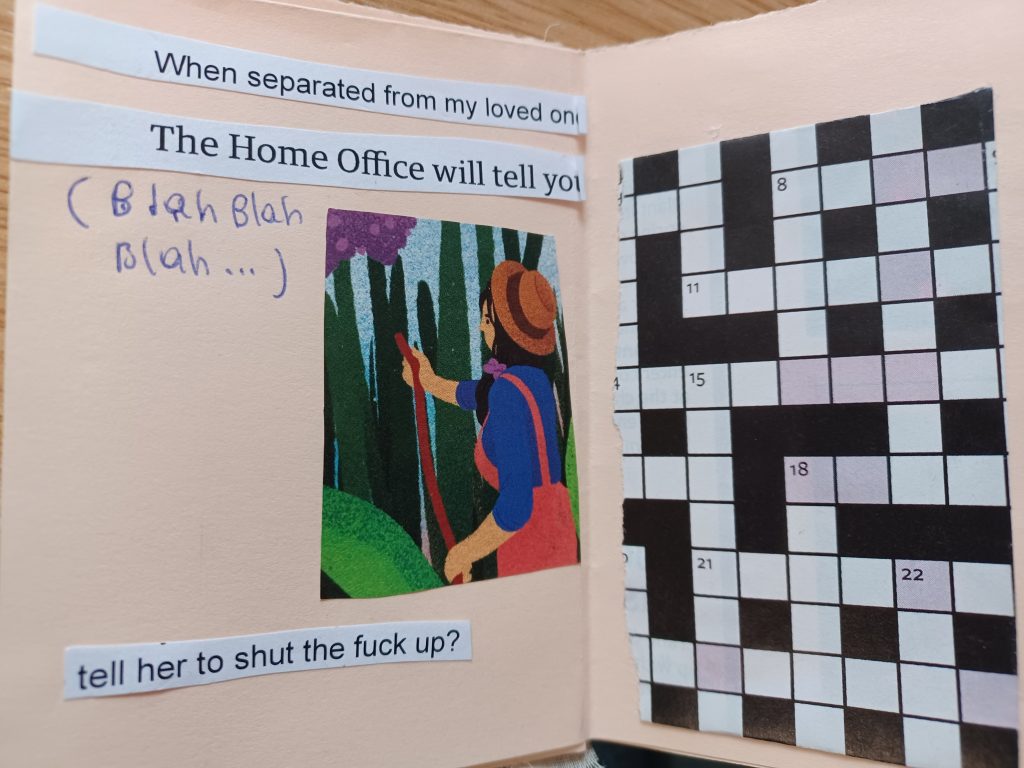
Participants played with the materiality of fabric, tapes, cut-outs from magazines and poetic texts, folding and cutting to create zines that made the impacts of the policies visible, elaborated counter-narrative, confronted problematic language and visual representations and re-shaped how they are framed. A data collection tool and a platform for visual storytelling, the zine workshop was a moment of collective work linking reflection and action. Below, I highlight some of the themes and techniques selected by the participants.
The materiality of the page that can be cut and re-shaped in different ways and the symbolism of a striped red tape lent itself to a critique of the ways in which the control enacted by the Home Office becomes all pervasive and risks atomising us and instilling a sense of suspicion, eventually leading us to introject the rules imposed on us and turn from observed into observing border guards.
By juxtaposing words and images, they addressed the linkage between the colonial pursuit of land and resources, the language of discovery and exoticism, and the extractivism still happening through visa fees and profit-driven carceral structures like hotels for sanctuary-seekers and detention centres, before calling for solidarity and shared humanity.
The zine represented an ideal medium to expose stereotypes and offer images for the feelings of going through the labyrinthine, endless treadmill of settlement applications.
The multiple directions in which a book can be read, and the materiality of a striped red and white tape were used to create tensons and oppositions between the ideas of Home (featuring a poetic text shared with us by poet Barsa Ray) and Home Office (featuring words from a newspaper article).
People played with words and their dispositions of the page, creating insightful conceptual interventions. For example, Sharon Watson articulated a critique of the colonial underpinnings of neoliberal discourses of deservingness permeating the rhetoric and policies of family migration (note that Mahmood’s proposal is also nicknamed “Earned Settlement”) and which are born of a racialised, imperial distinction between those who serve and those who deserve, all the while pointing to how these logics of deservingness makes us all servants to neoliberalism’s incessant demand to produce.
The combination of coloured paper, images and texts from different sources allowed irony to flourish in the chasm between ecological diversity and nationalism, travel and exile, the language of poems and formal documents.
But in other cases, it also allows authors to soften their approach, juxtaposing the harsh reality portrayed by testimonies of affected individuals with soft colors and soothing images that created an emotional counterbalance, or generating sensorial spaces of welcome by weaving together past and future geographies of belonging.
Why is this important now?
The Labour Government’s proposed changes to settlement for migrants arriving through different routes has encountered huge opposition from members of the public, charities, unions and even Labour MPs. Deep concerns were voiced by all but two attending MPs on February 2nd 2026, at a Parliamentary Debate. A mass lobby was organised at Westminster by the No Recourse to Public Funds Network on March 13th, and experts have been calling out mistakes in the estimated savings the Home Office would be making by introducing these measures (Elgot, April 13th, 2026, The Guardian). On March 23rd 2026, The North-East, Yorkshire and Humber Regional Conference voted unanimously to stand with migrants and a judicial review of the temporary ban to bring family members to the UK imposed on refugees by Mahmood in November 2025 is coming up in May. Amidst this concerted push back, the Government has delayed the introduction of the measures initially planned for April 2026 until autumn.
Artworks can provide critical commentary on geopolitical issues and make public policies and events that might otherwise be overlooked or forgotten. They ask us to spend time with fictional characters and adopt their perspectives, and importantly, effectively reach non-specialist audiences. Participatory artistic practices such as zine workshops also allow people to come together and engage with these matters in a non-frontal, non-confrontational way that makes space for real dialogue. And we must be clear: when the government attacks our private lives, we won’t keep it private.
This is why on Wednesday May 13th 2026, I will be running a creative writing workshop reflecting on how relationships – with lovers, neighbors, friends and the nation itself – fold and unfold under the pressure of Hostile Environment policies and rhetoric.
Taking place at the Institute of Advanced Studies in the Humanities (IASH), 2 Hope Park Square between 11am and 12:30pm, this workshop, part of the Festival of Europe Scotland, will use the prism of time, body, and connections to engage in a series of body mapping, free-writing activities and guided reflection.
Taking seriously Allan and Azrouk’s proposition that poetry can be considered a modern-day tool of diplomacy for recognition of contested citizenships and claims to rights (2024), the creative writing workshop will ask: 10 years on from Brexit, and 16 years after the introduction of minimum income requirements for UK citizens to sponsor their foreign partners, what does it mean to claim and assert belonging in the UK?
With permission from the authors, the resulting texts will be published in a booklet comprising poetry, illustrations, and prose, and people are invited to bring lunch and share a picnic in the beautiful garden at IASH.
More info and tickets about this creative writing workshop can be found here.
Originally from Italy, Dr Vanessa Montesi lives in Newcastle upon Tyne, where she moved in 2022 with a spouse visa. She is a postdoctoral fellow at the Institute for Advanced Studies in the Humanities (IASH) of the University of Edinburgh, and the Language and Learning Service Manager at Action Foundation, a charity supporting fellow migrants and people seeking sanctuary.
Holding a PhD in Comparative Studies from the University of Lisbon, and having worked as research assistant at Concordia University, Vanessa’s experience in arts education and participatory methods includes working as a Dance Lecturer at the University of Sunderland, editing and publishing several collections of multilingual poetry, collaborative filmmaking, and facilitating an international online Book Club for spouse migrants and their loved ones. She is the author of Dance as Intermedial Translation from Leuven University Press (2024).