
Challenging childism: Children as cultural and political actors
by Emma Davidson and Fiona Morrison
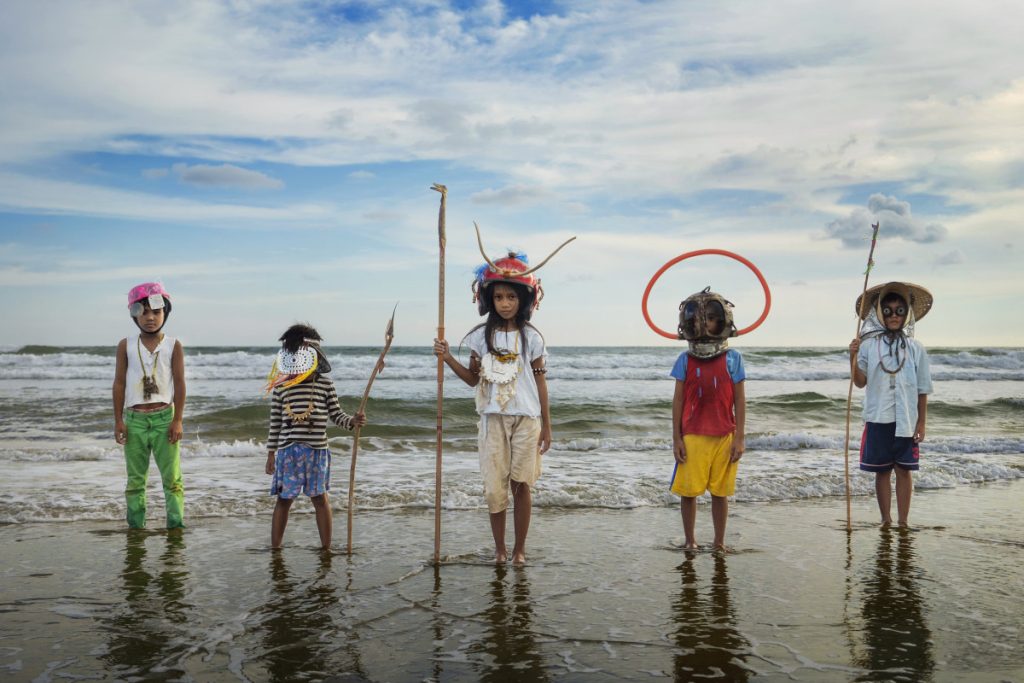
In 2025, a collaborative project brought together researchers, cultural institutions, artists, and children’s rights organisations to explore childism, a framework that challenges the structural marginalisation of children rooted in adultist assumptions about children’s competence, voice, and value. The project was galvanised by The Children Are Now, an exhibition at Talbot Rice Gallery (October 2025–February 2026), which examined how children relate to some of the most pressing challenges of our time, including climate change, mental health, conflict, and generational trauma.
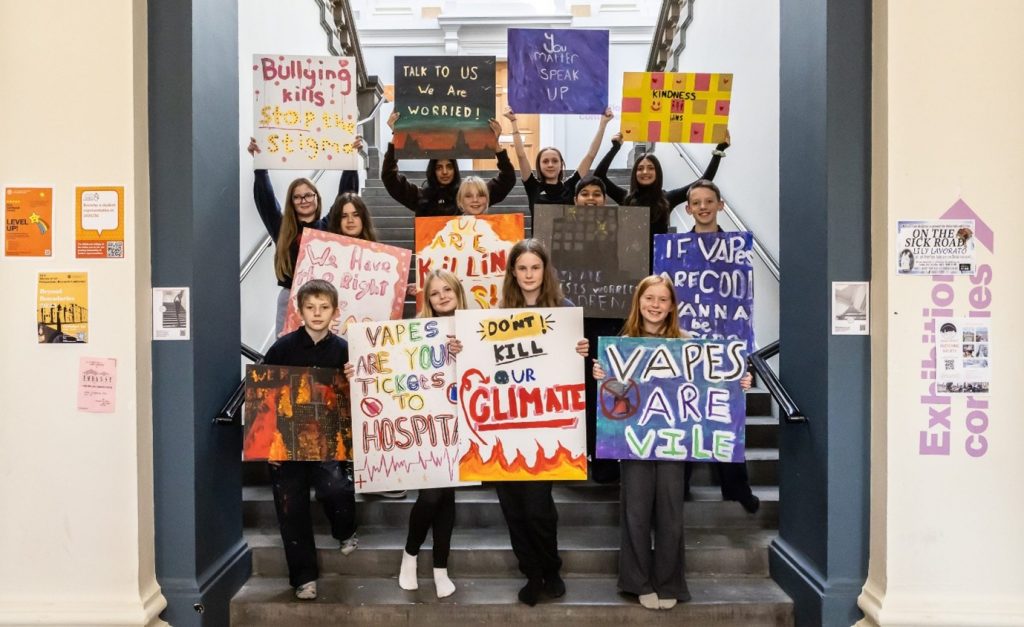
Rather than positioning children as future citizens or passive recipients of care, Children Are Now foregrounded children as cultural and political actors in the present. Central to the exhibition was a collaboration between artist Bob & Roberta Smith and a group of young people from the Children’s Parliament, known as the Child Human Rights Defenders. Working together, they produced a series of striking placards, each articulating a policy issue identified by children through the Children’s Parliament’s national engagement work. These works, addressing issues such as climate change, bullying, mental health, and vaping, became a focal point of the exhibition, asserting children’s priorities within a major university cultural space.
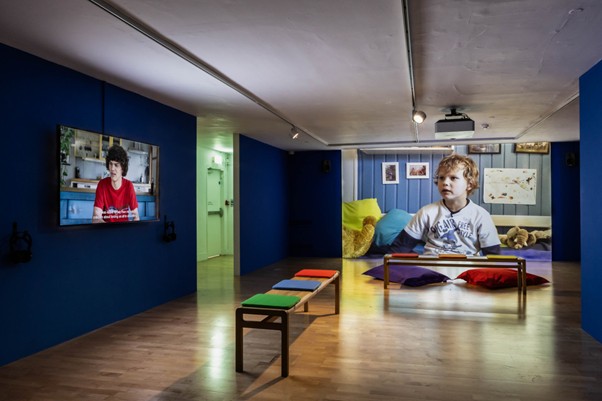
The exhibition also prompted a special assembly event at Talbot Rice Gallery that deliberately disrupted the norms of formal, adult-led engagement. Held in a grand university space usually reserved for official (and very adult orientated) occasions, the event re-made the room through children’s presence and practice. Bean bags, den-building, movement, singing, and theatre replaced fixed seating and long speeches. Children introduced speakers, contributions were short and dynamic, and bodies moved continuously through the space. The event culminated in Election by Bishop May Down, a powerful theatre piece imagining children as political decision-makers with real power, offering a child’s manifesto that was playful, incisive, and unapologetically radical.
The day concluded with a keynote lecture by John Wall, highlighting an interesting tension as the programme shifted back toward more conventional, adult-centred academic forms. This contrast, between the deconstruction of space and hierarchy earlier in the day and the return to familiar formats, has become an important point of reflection within the project’s ongoing work.
Alongside the exhibition and events, a five-session online reading group on childism formed a key strand of the wider collaboration. The reading group created a space to engage critically with foundational texts and applied perspectives on childism. Through discussion, participants examined how societal assumptions about childhood shape policy, research, culture, and everyday practice, and how these might be challenged to support more equitable, rights-informed approaches to children’s lives.
Taken together, this work demonstrates the value of sustained, collaborative approaches to challenging childism, not only in theory, but in practice, space, and institutional culture. The Talbot Rice exhibition provided the catalyst, Children’s Parliament led delivery of the participatory work with young people through their own staff, and research observation and interviews are now informing ongoing analysis, future briefing papers, and funding bids. The project continues to ask what it really means to take children seriously as contributors to cultural, political, and public life.
Collaboration and acknowledgements
This project was shaped through a wide, collaborative partnership across research, cultural practice, and children’s rights work.
The Children Are Now exhibition at Talbot Rice Gallery was led by James Clegg, whose curatorial vision provided the catalyst for the wider programme of activity around childism, culture, and children’s rights.
The academic programme work was led Dr Fiona Morrison, and supported by Dr Emma Davidson and Dalia Avello Vega (Binks Hub), Dr Marlies Kustatscher, Professor Kay Tisdall, and Dr Katarzyna Kaczmarska, whose expertise across childhood studies, policy, and politics informed the project’s conceptual framing.
The Children’s Parliament supported the Child Human Rights Defenders and led the participatory work with young people, with research support provided by Dr Minkyung Kwon.
Funding and institutional support for this work was generously provided by:
- The Binks Hub
- CAHSS Challenge Investment Fund, University of Edinburgh
- Centre for Research on Families and Relationships
- Children’s Parliament
- Children and Young People Thematic Hub, MHSES, University of Edinburgh
- Childhood and Youth Theme, CAHSS, University of Edinburgh
- Talbot Rice Gallery
Exploring Childism: Reflections from a multidisciplinary reading group
by Dalia Avello Vega
“Many of the things we need can wait.
The child cannot.
Right now is the time his bones are being formed,
his blood is being made,
and his senses are being developed.
To him we cannot answer ‘tomorrow’,
his name is Today.”
Gabriela Mistral’s words capture the urgency of children’s lives, the immediacy of their needs, and the moral imperative to centred them now rather than defer their wellbeing to some imagined future. Her words serve as a frame to reflect on the work conducted by a multidisciplinary reading group formed to explore a concept challenging how we think, research and advocate for children: Childism.
Over several months, our multidisciplinary reading group explored childism as both a theoretical lens and a political project in preparation for The Children Are Now exhibition at Talbot Rice Gallery. Many of us came to these sessions as newcomers to the concept, uncertain whether it represented a meaningful departure from existing frameworks or simply rebranded familiar ideas. What emerged was not a settled definition, but a productive tension between theory and practice, deconstruction and reconstruction, inclusion and transformation.
Our first session introduced childism’s contested terrain. We explored Wall and Warming’s distinction between adultism (systematic discrimination against children) and childism (a critical lens for transforming structural norms). The fluidity of the concept proved to be frustrating yet generative. Could this concept provide real change? In our discussion we questioned the actionable meaning behind ‘empowerment’, debated idealistic visions of children as ‘self-propelled wheels’, and reflected on where were children’s actual lived experiences in these philosophical abstractions. A recurring concern appeared and persisted throughout: the gap between theoretical precision and practical application, where we acknowledged our tendency to deconstruct without constructing.
Later we tackled a fundamental question: is childism simply rebranding what childhood studies already does? We discussed how the ‘new’ sociology of childhood offered descriptive and constructivist accounts of children’s agency, while Wall’s reconstructionist childism went further, demanding a transformation of the adultist systems underpinning research, academic work and society itself. A parallel offered with characteristics derived from different waves of feminism proved stimulating. Childism challenges structural oppression and interrogates how categories like ‘the child’ are constructed to justify exclusion. Wall’s emphasis on interdependence (that dismantling adultism will require both children’s voices and adults actively challenging the systems that silence them) lead us to uncover childism edge over more normative views: its refusal to settle for inclusion when transformation remains possible.
Erica Burman’s work introduced ‘child as a method’ as a conceptual orientation, distinct but compatible with the childism framework. While childism is rooted in philosophy and focuses on moral and ethical questions about children’s place in society, ‘child as method’ is an investigative orientation, explicitly political and anti-psychological, examining structures of power through the lens that is the child. This discussion troubled us, how does using children’s experiences to interrogate systems of power differ from exploiting those experiences? When does analytical distance becomes ethical abandonment? The discussion crystalised uncomfortable questions about our responsibilities as researchers, what does it mean to deconstruct without reconstructing or theorise without acting? We confronted our own positionalities and disciplinary origins, recognising how they shape what we count as legitimate knowledge. Ultimately, we concluded, if we are committed to emancipatory research, criticism alone is not sufficient.
Near the end of our time together we explored childism’s intersectionn with ableism through Adami’s work. The parallel discriminations (both rooted in perceived ‘lack of abilities’) revealed how environments designed for adult/abled bodies create socially constructed dependencies. The increasing medicalisation of children’s behaviours raised pointed questions: are diagnoses like ADHD addressing the children’s needs or pathologizing normal responses to oppressive environments? The concept of epistemic injustice resonated deeply. Children with disabilities face the possibility of compounding erasure, they might not be believed, not taken seriously, or be excluded from diagnostic processes about their own lives.
Throughout all the sessions, certain questions persisted: where are the children in these conversations? What would their understanding be of what is relevant to their lives? How do we move from critique to deliver change? Is working within adultist institutions too safe, or is radical outside status too impractical? These tensions may be childism’s strength: keeping us uncomfortable, questioning, moving beyond inclusion and towards a reimagination of the systems defining whose voices matter at the end of the day.
Sources
With gratitude to our group discussants: Kay Tisdall, Felicia Szloboda, Fiona Morrison and Emma Davidson.
Biswas, T., Wall, J., Warming, H., Zehavi, O., Kennedy, D., Murris, K., Kohan, W., Saal, B., & Rollo, T. (2024). Childism and philosophy: A conceptual co-exploration. Policy Futures in Education, 22(5), 741–759. https://doi.org/10.1177/14782103231185178
Wall, J. (2022). From childhood studies to childism: Reconstructing the scholarly and social imaginations. Children’s Geographies, 20(3), 257–270. https://doi.org/10.1080/14733285.2019.1668912
Burman, E. (2023). Child as method and/as childism: Conceptual–political intersections and tensions. Children & Society, 37(4), 1021–1036. https://doi.org/10.1111/chso.12615
Adami, R. (2024). Childism, Intersectionality and the Rights of the Child: The Myth of a Happy Childhood. Routledge. https://doi.org/10.4324/9781032638614
Reyes García, C. (2017). Gabriela Mistral (1st edn). Editorial Universidad de La Serena.
Imagining arts and cultural spaces with children and young people
by Minkyung Kwon
Introducing the project with children as artists
What might arts and cultural spaces look like if we imagined children as cultural and political actors? This question lingered with me throughout my involvement in the collaborative project that led to The Children are Now Exhibition – a project created together with Child Human Rights Defenders and adult staff from Children’s Parliament, the artist Bob and Roberta Smith, curators from Talbot Rice Gallery, and academic researchers at the University of Edinburgh.
In this blog post, I want to share my reflections on how I gradually came to understand what it might mean and what it might look like when children and young people are part of shaping arts and cultural spaces. I do this by reflecting on my experiences of moving, working, and thinking alongside both children and adults across the shared times and spaces of this project.
I joined the project as a research assistant, and over time I took on many different roles. Before the Residential began, I engaged in conversations with Children’s Parliament staff, Talbot Rice Gallery curators, and university researchers to develop a shared understanding of childism and child-rights approaches. During the three-day Residential itself, I worked closely alongside Child Human Rights Defenders, who acted as artists and created placards for the exhibition with the artist Bob and Roberta Smith, and groups of adults who supported child artists’ creative work. I also attended the Launch Event of The Children are Now exhibition, where the child artists spoke publicly about their work, to support their contributions. Shortly afterwards, I took part in the Child Assembly, where child artists, adult staff, and I shared our reflections with an audience about what it had meant to be part of the project.
Even after these formal events had come to an end, I continued to visit The Children are Now exhibition – sometimes alone, and at other times with friends or with primary school children who were curious to learn more about our work. Whenever someone asked me how it was to work with Child Human Rights Defenders as artists, my thought kept circling back to one particular place and scene: our “wee workstation corner” in the Studio during the Residential.
Our wee workstation corner
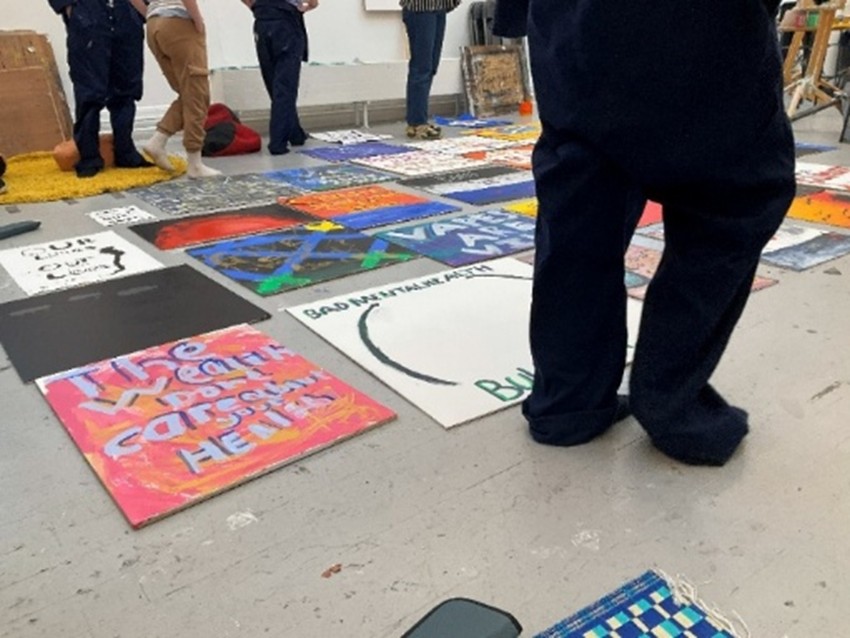
For our Residential, we used the Studio space in Edinburgh College of Art building – a spacious, bright room with huge windows. When we entered the Studio, colourful rugs and bean bags were spread out on the left-hand side, inviting people to rest, play, and feel at ease. In the centre of the room was an open floor space where child artists gradually laid out and gathered their finished placards. On the right, twelve easels stood in a circle so that every child artist could work on their own placard while still feeling connected to one another.
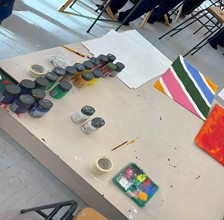
Between the circle of easels, the wall of portraits drawn on our first day of the Residential, and the completed placards spread across the floor, sat the wee workstation corner – a small but vibrant hub, as you can see in the photograph.
During the Residential, I loved watching the bustle and energy that constantly flowed through this corner. It became the heart of the Studio – a place where everyone passed through, paused in, or gathered, carrying the shared hope that by the end of the Residential, thirty-six placards with powerful messages from child artists would be ready to be displayed in the gallery.
This was the place where children came to experiment with colours, test ideas, and decide what they wanted their placards to look like and which colours they would use. It was where they asked for extra materials, like brushes, water pots, tape, paints, and where adults responded to those needs by offering practical support. It was also where children brought their work-in-progress to Bob and Roberta Smith, eager to hear his thoughts before returning to refine their pieces. The corner was where children expressed their needs for a break, more time to work, or changes to the programme schedule.
It was also a space where our roles shifted fluidly. “I’m their assistant today!” Rona, a member of staff from Children’s Parliament, joked on the third day, bustling back and forth with water pots, brushes, and phrase banks so that the child artists could stay focused on their work. At times, the corner became a place of disagreement and debate. Some children challenged Bob and Roberta Smith’s ideas about art rather than simply accepting them.
“If I were you, I’d add this word to your slogan,” one child artist said to another as they stood together by the wee workstation corner. Gradually children began taking on more active roles in giving each other feedback, aiming to sharpen their messages so they would speak clearly to a wider audience. In this same corner, some children began collaborating on a new placard together.
It was also in this space that a child artist and I decided together when, and in what ways they wanted to share their experiences and opinions with me as part of the research. Around this corner, on the first two days, many adult staff members supported the children by asking about their intentions behind their drawing and slogans, trying to come up with ideas. By the third day, however, some adults began to reflect that perhaps it would be better to step back a little, to give the child artists more uninterrupted time and space to concentrate on their work.
I loved witnessing everything that unfolded in our wee workstation corner – the movement, the conversations, the shared decisions, the negotiations, and the creative and supportive energy. It was a place where boundaries between ‘adult’ and ‘child’, ‘artist’ and ‘assistant’, ‘organiser’ and ‘participant’ became porous and flexible.
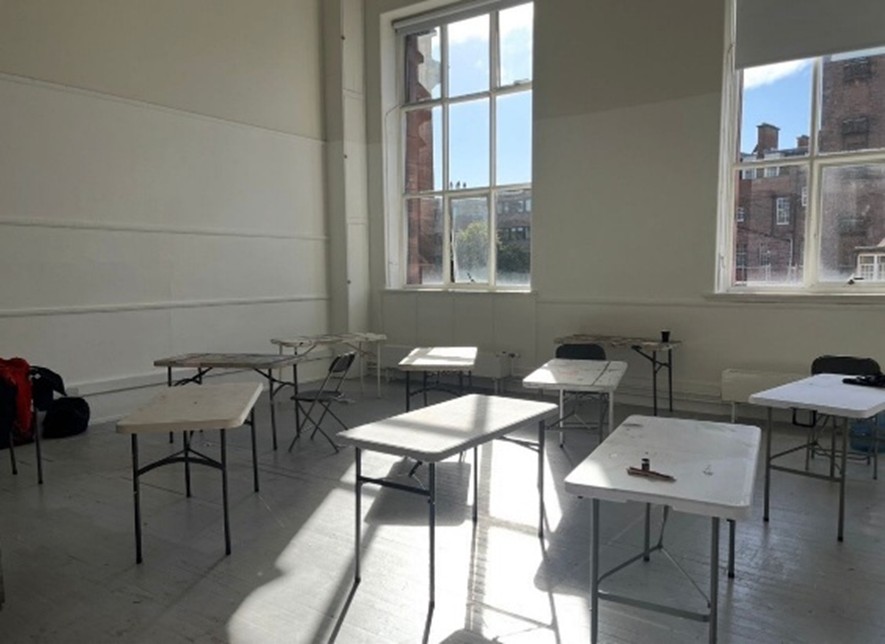
Seeing these dynamics also made me think back to how space and roles were arranged on the very first day of the Residential. On that day, when we painted portraits in pairs, everyone sat at shared tables facing one another, as illustrated in the photograph. Along the opposite wall from the windows stood a long table with paints and materials on top. Bob and Roberta Smith and James, the curator, sat together at a table positioned between this table with paints and the tables where the child artists sat.
After Bob and Roberta Smith demonstrated each step of how to draw a portrait, James moved around the room, squeezing the same paints onto each group’s palette. As a result, every table ended up with nearly identical colour palettes. Looking back, there was far less movement, conversation, and lively circulation of people compared to what later filled the wee workstation corner. Without intending to, the layout of the room created an invisible boundary: between the paints (the material resources), the professional artist and curator (holders of artistic expertise and resource), and the children (who appeared to need guidance and access to these resources).
In contrast, the wee workstation corner that emerged in the following days felt much more shared, fluid, and alive – a space where children, adults, materials, ideas, and decisions moved together.
What enabled our wee workstation corner?
What, then, made it possible for the Studio to shift from identical paint palettes laid out on tables to the lively, shared atmosphere of the wee workstation corner?
Some of the conditions had already been discussed before the Residential began. These ideas came partly from Child Human Rights Defenders and partly from Children’s Parliament adult staff, and together they shaped the ethos of the space. We agreed on using child-friendly furniture and materials such as cushions, bean bags, and colourful rugs so the Studio would feel less like a formal institution and more like a welcoming and child-friendly environment. We built in playful activities, shaped parts of the programme so that some sessions were led by children, and made an effort to be present with children beyond project tasks: for example, by having lunch together. Adults also committed to putting their phones away while children’s phones were collected in a bag, avoiding leaning over or commenting on children’s work, and dressing in ways that felt less formal, serious, or overly ‘adult-like’. These choices subtly but significantly shifted the mood of the space.
Reflecting on what I observed and felt during the Residential, I also think that the dynamic energy of the wee workstation corner was enabled by the responsive approaches taken by adults. For example, adults – Bob and Roberta Smith, James and Sarah (the curators), and Children’s Parliament staff – often paused to check in with children when using professional terminology, whether about Talbot Rice Gallery, art schools, artistic techniques, or how cultural institutions operate. They aimed to share knowledge without slipping into overly ‘teachery’ roles. They often ended the sentence with a suggestive tone, saying “this is how we do it in art school but you can do whatever ways you like to do.” In interviews, children told me that they valued having access to different kinds of professional expertise, because it helped them learn, improve their skills, and think more broadly about how their messages might reach wider audiences.
I was also struck by how responsively adults acted upon children’s feedback. Through individual and group interviews with the adults, I came to understand that facilitating genuinely child-led approaches was not always easy. Practical constraints such as time, funding, and resources, often limited what was possible. Still, throughout the project, I did think that children shared feedback about the Studio and Talbot Rice Gallery spaces, the scheduling of activities, and the ways they wanted to express their ideas through art. They also expressed their preferred ways of delivering thoughts be it through labels writing, drawing, slogans, or speaking through interviews.
What mattered more was how adults responded to these feedbacks from children. Rather than dismissing or overriding children’s ideas, adults explained why institutions sometimes work the way they do, shared background context of their ways of working, and then left the door open: acknowledging that things could be shaped differently. Adults often followed up with open questions, inviting children to imagine how they would like the space, programme, or exhibition to look instead. This created a sense that children’s feedbacks were not just heard, but actively considered.
Finally and most importantly, I felt that there was a strong shared understanding among the adults that children were not simply participants, but co-contributors to this project with their own forms of expertise. Each group brought different, yet interconnected and complementary knowledge to the project: artists brought artistic practice and expertise, curators brought institutional insight and the platform, Children’s Parliament staff brought experience and skills in supporting child participation, and children brought their lived experiences as young political actors. This recognition enabled the placards to centre around the issues that children living in the present moment felt were most urgent and important.
Imagining arts and cultural spaces through the image of our wee workstation corner
Today, before beginning to write this blog post, I returned to Talbot Rice Gallery to visit The Children are Now exhibition with a friend who wanted to learn more about the work of the child artists. When we arrived, a group of primary school students was already there, moving through the gallery together. Curious to hear how they responded to the placards, I joined them into the bright room on the second floor where the thirty-six placards are displayed.
“Wow! This is so cool!” one child exclaimed, stepping closer, wanting to touch the work and take it in from every angle. Soon they were talking excitedly with one another with the support from the facilitators of the Gallery, recalling where else they had seen similar placards, connecting them to protests for Palestine, Black Lives, and climate justice. As they learned that Child Human Rights Defenders had created these works, they began sketching ideas for their own placards using the child-friendly worksheet provided by the Gallery.
In the next room, where a documentary film about a ‘rebellious’ child at school played in the background, my friend (an adult, researcher at the University) and I began talking about the exhibition and my experience of working collaboratively with children and adults. Downstairs, families with young children moved through the space in buggies. I overheard a young child hesitating in front of a large figure of a monster on the wall, partly fascinated and partly unsure while their mother gently encouraged them forward. Nearby, two adults approached the group of visiting children who came to watch the documentary film and said, “Well I’ll join this group here. I’d really like to hear what they think about the film.” At the entrance desk, a receptionist kindly responded to a child visitor who wanted to take the poster that she could take postcards too so she could share them with friends who couldn’t come to the gallery.
For a moment, I stood alone in the gallery and simply tried to feel the space. It was a place where adults and children of different ages, with different backgrounds and interests, moved together. It was a space layered with overlapping voices, questions, curiosities, and interpretations.
As I stood there, my mind drifted back to the hustle and bustle of our wee workstation corner: the quick footsteps of child artists and adults circling around the placards, the constant movement of materials, ideas, and conversations. I also thought about the Launch Event and the Child Assembly that followed the opening of The Children Are Now, where children, families, artists, curators, researchers, children’s rights practitioners, and arts and cultural professionals all moved around together to shape events that were more child-friendly.
What makes such spaces possible, inside and beyond Talbot Rice Gallery, where children, adults, institutional stakeholders, and everyday visitors come together, creating such a lively, dynamic, and shared atmosphere?
I want to end this blog post with a question inspired by Kirsty, one of the Children’s Parliament staff, who raised it during our group interview after the project concluded: What remains to be done for arts and cultural institutions to make every stage truly child-friendly and involve children throughout the entire process?
The child artists themselves offered powerful insights that begin to answer this question. They said that having their thirty-six placards displayed in the gallery does make a clear difference. They pointed out that they often see artworks of children in galleries and museums, but rarely artworks by children about their own lives and concerns. They explained that having children’s artwork in the galleries is important especially for other children who might feel isolated or unheard because it shows them their experiences are valid and visible. They were proud of their work, repeatedly emphasising how hard they had worked and how much effort they had put into it.
They also wanted adults to understand something important: that they are children, and that they can do the type of things that adults think they can’t do. At the same time, they appreciated having access to “proper” set of tools, learning new skills, and seeing their work displayed in “such a big gallery” – a space that signalled that their opinions truly matter. Yet, they were also clear that not every child has these kinds of opportunities, and that this is something institutions need to reflect on.
So, what can we take from children’s reflections on participating as artists in this collaborative project? And how might adults and institutions work differently so that the spirit of the wee workstation corner, along with the Launch Event, the Child Assembly, and The Children Are Now, as starting points, can be seen and felt more broadly across arts and cultural spaces?
These are the questions I leave with you.
With thanks to Emma Davidson, Fiona Morrison, Dalia Avello Vego and Minkyung Kwon for contributing these pieces.
Find out more about The Children Are Now exhibition on the Talbot Rice Gallery website.