
A guest blog from our Co-Director Emma Davidson and researcher Helen Berry.
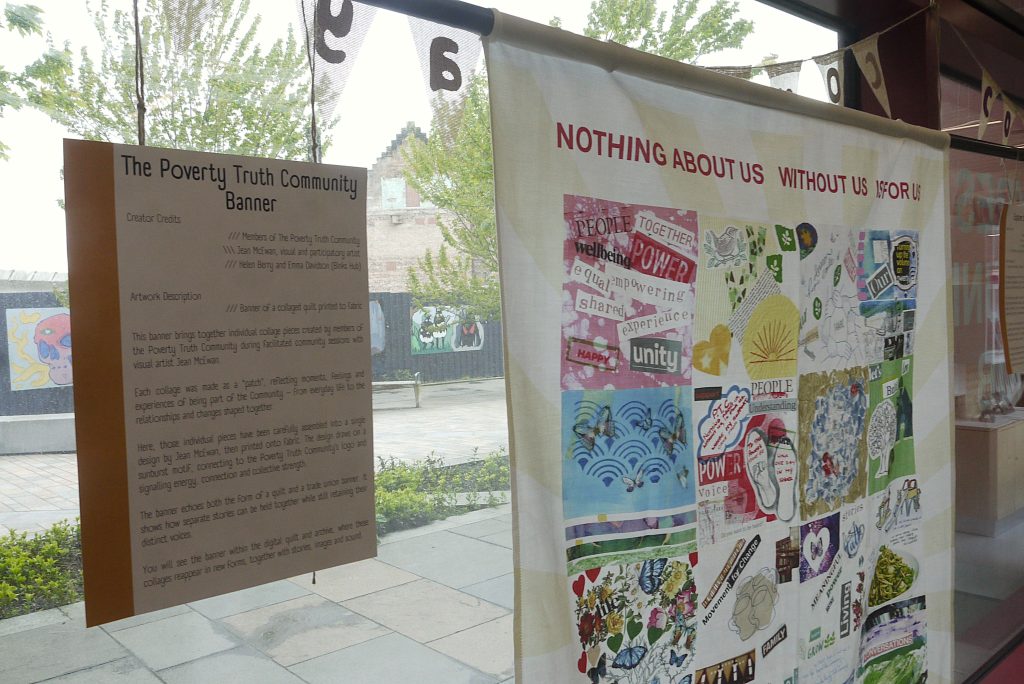
From 19th-22nd May we opened ‘Come Away In’, an exhibition developed collaboratively with members of the Poverty Truth Community (PTC), and generously hosted by the Byres Community Hub, University of Glasgow. It brought together stories, objects, artwork, photographs, soundscapes, the Digital Quilt (an interactive multi-media resource developed by the Binks Hub with artist Jean McEwan) and the new community micro-archive.
Over four days, the exhibition space remained open to visitors. We welcomed members of the public alongside policy-makers, funders, academics, community organisations and elected representatives – and of course, many of those who are part of the Community and its history in diverse ways. More than thirty people came through the exhibition each day, and many stayed much longer than expected.
In our visitor book, people wrote about the creativity of the exhibition and the way stories were communicated through objects, images, sound and conversation. Certain words also kept appearing: hope, inspiring, meaningful, community, stories and love.
What was striking for the team was not simply how many people came, but the way in which they engaged. Visitors listened to soundscapes, sat together around a table, handled objects, read stories and moved through spaces created collectively by the Community. Community researchers and members of staff attended each day to proudly show their work, and many good and deep conversations were had. Knowledge here was not simply being reported, nor was it one-directional. It became something to hear, feel and share with others – the nature of the exhibition invited people to be agents in making sense of the materials.
There is something important in this. We often hear technology being discussed as the next societal ‘revolution’, and it undoubtedly it impacts on us all. The Digital Quilt and community micro-archive, for example, uses technology to create new ways of weaving together stories and opening access beyond physical spaces to different kinds of data that feel immediate and intimate to their audience.
But perhaps this exhibition also showed that there is a quieter revolution taking place. Where the value is increasingly understood as people coming together around shared goals of social justice and equality, around listening, around making things together, and around creating spaces where stories can be shared differently. Indeed, this is the way the Poverty Truth Community has always worked – in stark contrast with the systemic injustices related to poverty, which it resists and pushes against.
We have talked before about the importance of slowness in this work, and this project is a good example of how relationships, community work and trusting collaborative research take time.
Talking with those who came away into the exhibition helped remind us that this project is not happening in isolation: there are so many small acts of collective work taking place around us, and together they can become something much larger.
If you haven’t already engaged with our project , we suggest you start with our Digital Quilt. It offers a unique, immersive and affective way to experience stories of connection, creativity and change emerging from the project. From there you will be led into the community micro-archive.
For us, the work continues. Our hope is that people engage with these resources, use them within teaching, learning, community practice and research. We would love, also, to see the archive grow, allowing us to continue the conversations it has started.
Come away in and be part of the story.
For more information on this project, visit: