A guest blog from Marie Larsson, a Research Fellow at the University of Edinburgh.
After curating my first poetry exhibition I have a deep, new-found appreciation for sticky-backed velcro strips. And just how much effort goes into hanging one picture on a wall – let alone a whole roomful. And, most of all, for colleagues, friends and family who are willing to lug A0 sized Foamex boards and boxes of frames across Edinburgh despite amber storm warnings. Research truly is a collaborate team effort, best enjoyed and most beautiful when done with others.
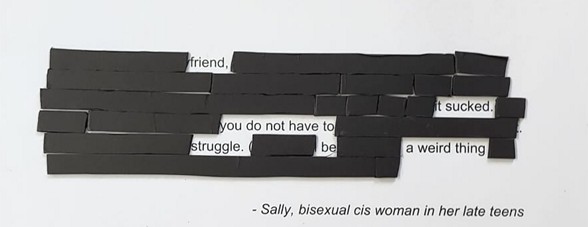
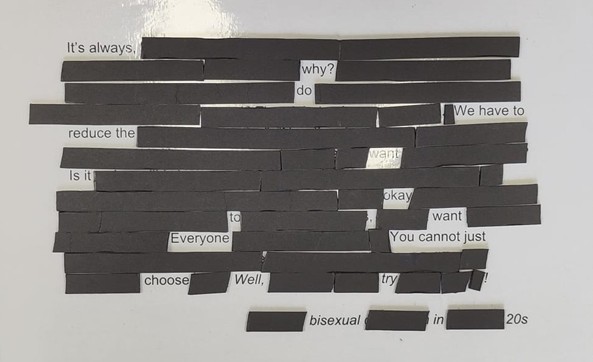
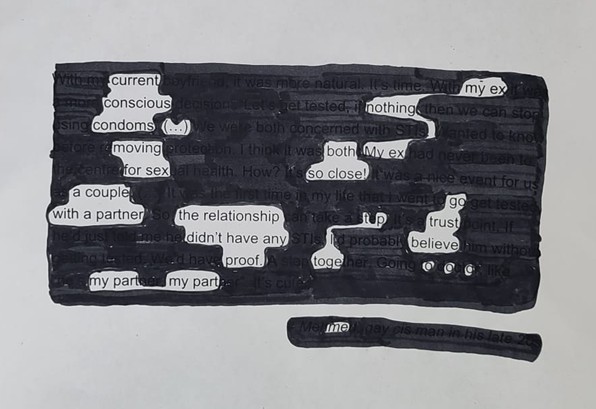
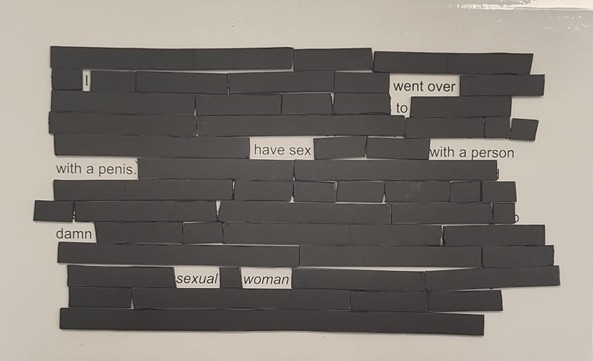
Over the course of 2025, I have been working a small (passion) pilot project exploring contraceptive experiences and knowledge production through poetry, which culminated in an exhibition titled The Pill. Angry Chuckles, that launched at the end of September. The exhibition drew from a half-day workshop held in May (facilitated by Autumn Roesch-Marsh) with people with a particular interest in or experience of working with contraception, abortion and sexual and reproductive health, which centred on writing poetry in relation to (and with interview material from) my doctoral thesis The Work of Contracepting: Young people’s experiences and practices with contraceptives in Sweden.
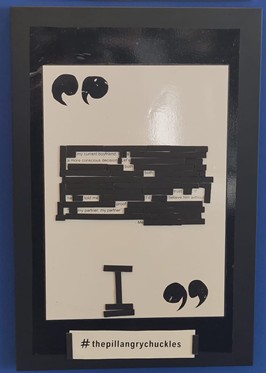
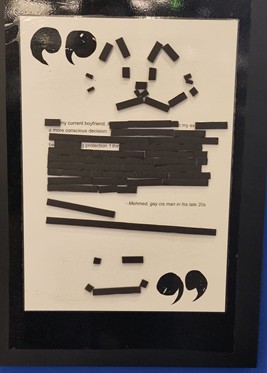
In the end, almost all workshop participants agreed to exhibit their poetry. Participants contributed a total of 22 blackout poems, eight golden shovel poems, and four free-form original poems. Over the summer, I worked with my dear friend and artist Frank Rokhlin to design templates for the poems and information boards that would guide the visitor through the exhibition.
First Stop: Considering Contraceptive Justice with GENDER.ED
Finally, one early Friday morning in September, the exhibition sprung to life in the foyer of Chrystal Macmillan Building (CMB) at the University of Edinburgh on George Square, amidst new students trying to find their way to their first lectures or tutorials. Through the excerpts, the poetry drawn from them, and accompanying artworks by artist Frank Rokhlin, the exhibition explored a wide range of experiences and interpretations – a dialogue between interviewees, researchers, poets and readers on shared and contrasting experiences of contracepting.

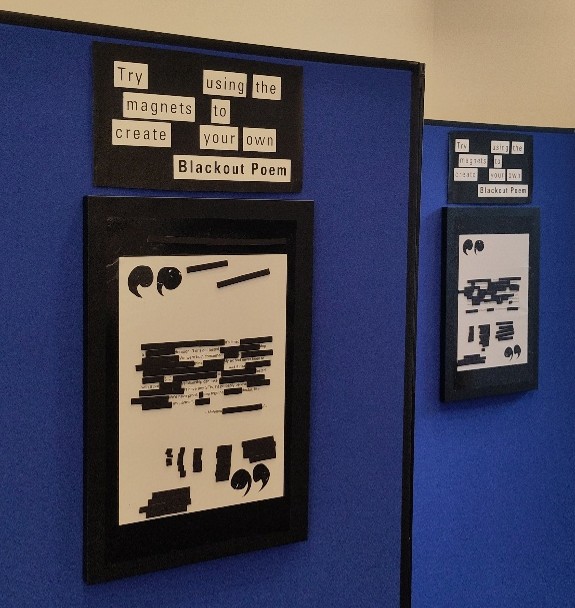
The exhibition invited visitors to take part in this dialogue through personal reflection, discussion, and even developing their own found poetry based on the interview excerpts. The idea of having an interactive element where visitors can craft their own blackout poetry came from Nel Coleman, an invaluable colleague and collaborator on the project, and ended up being one of the exhibition’s most playful and appreciated elements. I regularly discovered new, anonymous blackout poems created on these boards, and wondered how many more had been created and erased over the past week. At times I would find students and staff stopping – some cautiously, others deep in thought – and gently moving around the magnets, leaving their touch on these contracepting stories.
On the exhibition’s final day at CMB, Thursday 25th September, it featured in the GENDER.ED hub’s annual Welcome Reception to kick off the new academic year. The event began with a networking reception and an opportunity to engage with the exhibition. I did not have as much time to chat with visitors as I would have liked, but based on the conversations I did have, guestbook entries and the anonymous found poetry – it seemed to be resonating more than expected. One person wrote in the guest book: “Thank you for putting the anger & confusion that so many people with uteruses feel into words.”
This was followed by a roundtable discussion on “Researching Contraception, Gendered Relationships and Social Justice” providing context and further exploring the exhibition’s themes. Besides myself, it featured Lauren Galligan (Research and Participation Worker at The Young Women’s Movement), Arushi Sahay (visiting PhD Researcher investigating female surgical sterilisation in India), and Lucy Lowe (Head of Social Anthropology) as chair. During the roundtable we talked about the paradoxical nature of contraception as a technology that can be simultaneously liberating and oppressive, across scales from the personal to the global, and in ways shaped by intersecting forms of inequality and privilege. We also discussed the importance and challenges of involving communities and people with lived experience in research and policy in ways that are meaningful, and more engaging and creative.
Second Stop: Exploring Creative Methods with IASH
The next evening, Friday September 26th, we continued discussing the role and value of creative methods in research on sexual and reproductive health at the next exhibition venue, The Institute for Advanced Studies in the Humanities (IASH).

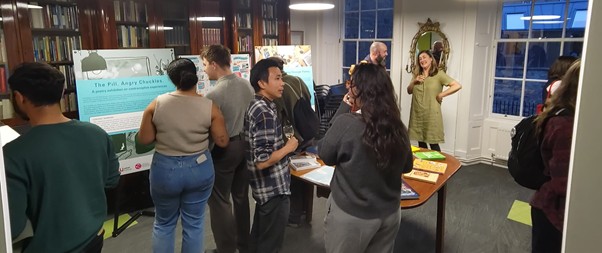
After an intense morning and day of hurriedly dismantling the exhibition at CMB and shuttling it over and setting it up at IASH, it was time for another (more intimate) roundtable event and drinks reception celebrating the exhibition launch together with workshop participants, colleagues, and some family and friends.
The evening began with a live-streamed conversation with Chase Ledin and Nandini Manjunath, chaired by me. Chase is a social scientist at the Centre for Biomedicine, Self and Society researching biomedical innovation and disease elimination, HIV/STI prevention and sexual health, critical public health, and health promotion using qualitative, collaborative, and creative methods including zine-making. Nandini is a registered Dance Movement Psychotherapist, Trauma therapist, Choreographer and Lecturer in Arts Therapies at Queen Margaret University, specialising in arts-led research and is passionate about bringing the creative into the academic, who attended as part of Theiya Arts.
Chase, Nandini and I, together with participants in the room and online, discussed the role that creative or arts-based methods has played in our respective research and the role it can play in addressing the often clinical, distant and disembodied nature of conventional forms of research on sex, contraception, sexual health and reproduction. We also reflected om how creative methods can contribute to rethinking dominant academic paradigms in and approaches to doing research and involving communities. Nandini explained how she became interested in rethinking how research is done with communities and what it means to decolonise research. She reflected:
Both Chase and Nandini spoke about their interest in and the meaningfulness of trying to create communities and spaces for connection and creativity, where people can move and be moved with and by each other and ourselves. Chase shared:
An interesting provocation that someone said in one of my [zine-making] workshops was that “this is a space where I can create the sex that I want, and I can create the sex that I imagine to be in the world.” This for me was an interesting provocation that allowed me to continue doing this work. I learned that this is a constructive way of being with each other using an artistic form. (Chase)
Building on that, I shared something I had been pondering together with Autumn ever since starting the project in early 2025, about poetry and other artistic/creative forms, and their ability to capture the more “intangible, difficult-to-pin-down experiences”, because a lot of research in this area, coming from an academic space is not really interested in such ineffable aspects that are hard to funnel into shaping policy and service design.
This discussion also kicked off in the room, with reflections on what valuable research outputs look like, the tensions around collaborating with policymakers and having policy as the main measure of valuable research impact. One audience member reflected – in the context of their creative work, research, teaching and engagements – on the impact that is not and cannot be represented through policy:
all manner of… impacts with beautiful little lowercase i’s sort of flutter out into the world. None of which is to downplay the importance of the role that the academic and the researcher can play in capital I impacting capital P policy, right? But… We find ourselves herded down these cul-de-sacs where we remain, and, you know, one of the things that working creatively offers, to me at least, is (…) can my creative work have an impact upon an arena which is not just not very creative, but anti-creative through being bureaucratised and standardised, you know what I mean? Well, maybe not, so maybe that’s not the impact that my research should even imagine it can do. But maybe the students I teach, the people I interact with. (Jimmy, audience member)
Already well over time, we wrapped up the roundtable on this note. Conversations continued over drinks, with audience members perusing the poetry, sharing which poems spoke to them the most, and making new connections – leaving my heart full of beautiful fluttering little lowercase i’s.
Final Stop: Reanimating Research at Doors Open Day
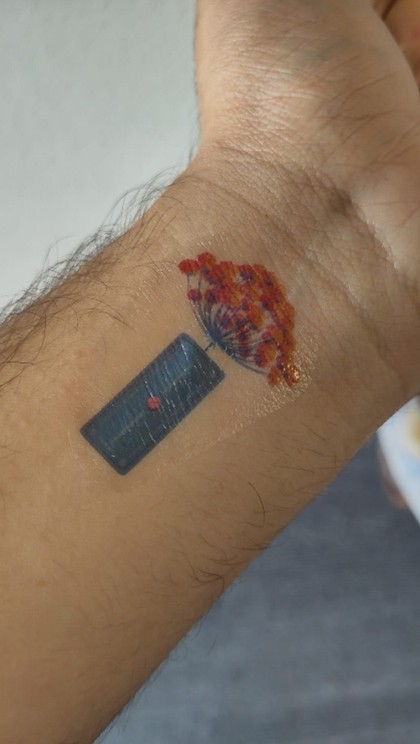
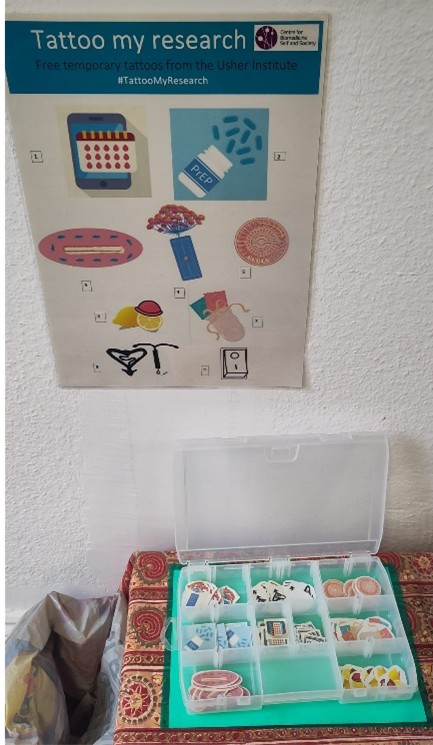
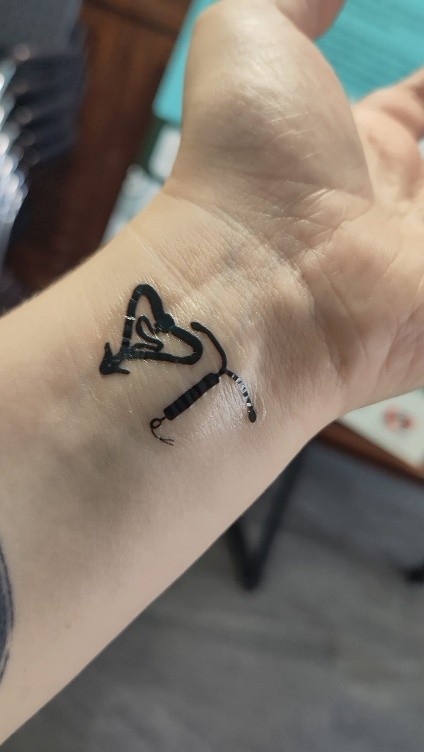
The third and final event in the launch of The Pill. Angry Chuckles was with the wider public as part of this year’s Doors Open Day. Early Saturday morning, coffee and fresh pastry in hand, I returned to IASH for a quieter exhibition day with time for in-depth one-to-one conversation and reflection. After two creatively, intellectually, emotionally and physically demanding days, I was glad to join Ben and Lauren (who work at IASH and generously invited me to join them for this year’s Doors Open Day) for a day of slowing down, enjoying the shared silence of flipping through books and reading poetry with strangers, and offering – to the delight of some visitors – temporary contraception tattoos (This was part of the “Tattoo My Research” engagement and outreach project, run by fantastic colleagues at the Usher Institute.)
Visitors trickled in throughout the day. Some shared that they found it interesting due to their background as a nurse, pharmacist or researcher or their current studies. Many I only shared a smile or nod with, seemingly content to explore the exhibition in solitude. I enjoyed having time – and seeing others take time – to play around and make more of my own blackout poetry using the magnetic boards or simple pen and papers.
As the day came to a close, I thought about the kinds of responses the exhibition had evoked in people and was taken slightly off guard by the emotive, visceral reactions: that they had “teared up” and “some poem hit me like… [tapping their chest]”. I looked through the handful of lovely comments left in the handmade guestbook. Someone had written:
This is a lovely merging of different people’s experiences, and it’s wonderful to see what these personal experiences look like through the eyes of others. I’m glad you’re making this kind of space for people’s stories : )
Reflecting on the past three days of walking, talking, sitting, breathing and pondering poetry and stories of contraception, this captures some of my own key takeaways from the experience. That is, the beauty of creating and having space for encountering other people and their stories, emotions, experiences, thoughts and reflections – through the poetry and art on display, but also all the conversations I ended up having while scrambling to curate the exhibition.
In doing so, I ended up re-encountering the conversations I had with participants from my PhD project and the poems workshop participants wrote in May. Stories reanimated through poetry. Meeting them again, I realised how numb I had become to the excerpts I spent hours analysing and theorising. The caring touch of others, facilitated by magnets or markers, made me see the words and the real-life person and story it reflected with new eyes. Like processes of much conventional research methods and academic projects, the logistics of the work had subtly but effectively distanced me from the humanness and realness on display. Taking a moment and having the space to pause and reflect and share, sometimes vulnerably and creatively, is clearly something that we need to prioritise more, particularly in academia and research.
What’s Next
After this concentrated – intense but wonderful – three-day experience of launching The Pill. Angry Chuckles., there have been a couple of smaller outings where I have been able to showcase the exhibition and talk about the wider work. This included the Binks Hub Showcase Poverty, precarity and community empowerment: Who decides? on September 3rd and the Outwith Showcase 2025: Meet the Partners! on October 8th. At both of these events I was able to encounter and connect with others doing or involved in research using a variety of creative or arts-based methods. The only problem now is that I have become inspired to do not only more poetry, but collaging, zine-making, weaving, quilting, ceramics, and oral storytelling just to name a few!
Up next, I am still hoping to find new places and venues interested in hosting the exhibition – ideally for a longer period of time. In the spirit of creating time and space to reflect and connect with each other I am also, together with Autumn and some workshop participants, embarking on a small creative writing project with the aim of developing a paper on the power of poetry in research and knowledge production around contraception. While the pace of the showcasing is slowing down, I suspect it is in many ways the beginning of a new chapter for me as a contraceptive researcher – of carving out time for sitting in the not-knowing, in paradoxes and possibilities, and in having an angry chuckle over contraceptives with a stranger or a friend.
Marie Larsson is a Research Fellow at the Centre for Biomedicine, Self and Society, University of Edinburgh, currently working on abortion and contraceptive care in Scotland. Her doctoral research examined “the work of contracepting” and young people’s experiences and practices with contracepting in Sweden.
As a critical sociologist and qualitative researcher, she is passionate about improving experiences and highlighting injustices in sexual and reproductive health, contraception and abortion through research, teaching, community engagement, and creative collaborations.
She is currently dreaming of doing a research project on contraceptive storytelling in romance novels – combining two of her favourite things in the world: reading the romance and critically thinking about contraceptives!
To keep up with her, you can follow Marie on LinkedIn here.