

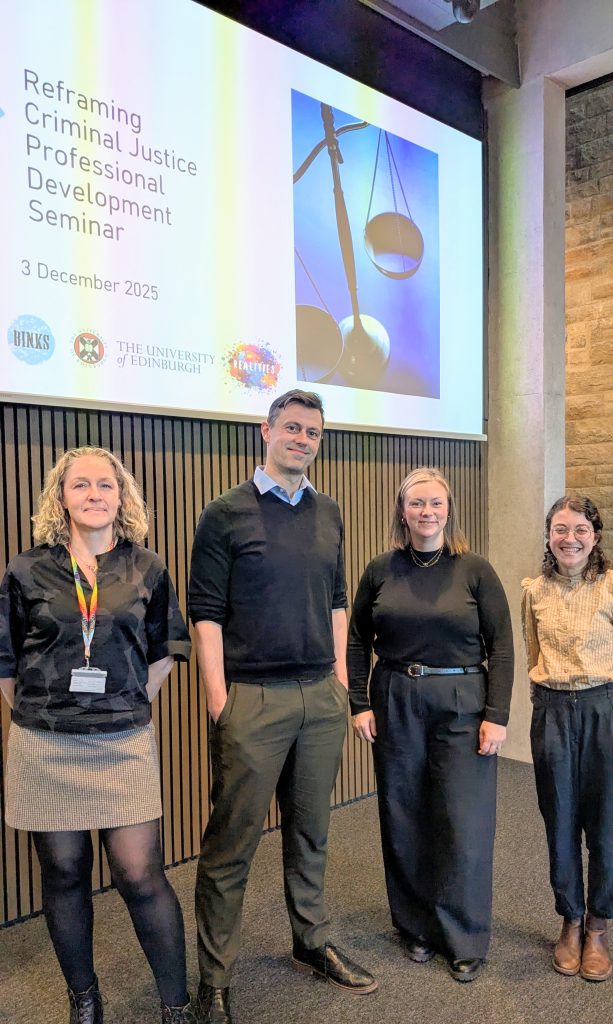
The half-day seminar, ‘Reframing Criminal Justice Professional Development’, was organised by the Binks Hub and REALITIES team and took place on 3rd December 2025. The session brought together academics, policymakers, practitioners and students to consider how different aspects of criminal justice have been and may continue to be reframed.
We started with an introduction to REALITIES (Researching Evidence-Based Alternatives in Living, Imaginative, Traumatised, Integrated, Embodied Systems, a UKRI funded project) by the Principal Investigator of REALITIES, Dr. Marisa de Andrade, and Early Career Researcher on the project, Dr. Alexandra Jundler. This was followed by presentations from three community-embedded researchers in REALITIES: Sam Rowe, Lucy Campbell and Deborah McArthur.
The REALITIES research project is rooted in community-based research and is largely structured around five community hubs based across Scotland, including Edinburgh, North Lanarkshire, Dundee, Clackmannanshire and Easter Ross. The intention is to re-imagine the health and social care systems, including the criminal justice system, to better tailor to the needs of communities.
In each of the presentations, the community-embedded researcher discussed how, on the hyper-local level, there is not always one way that the criminal justice system has to proceed. Instead, the presentations offered a space to reconsider and reframe how criminal justice has been and may be successfully implemented. Following these presentations, we provided a space for brainstorming together in regard to how we may extend and continue this thinking and practice.
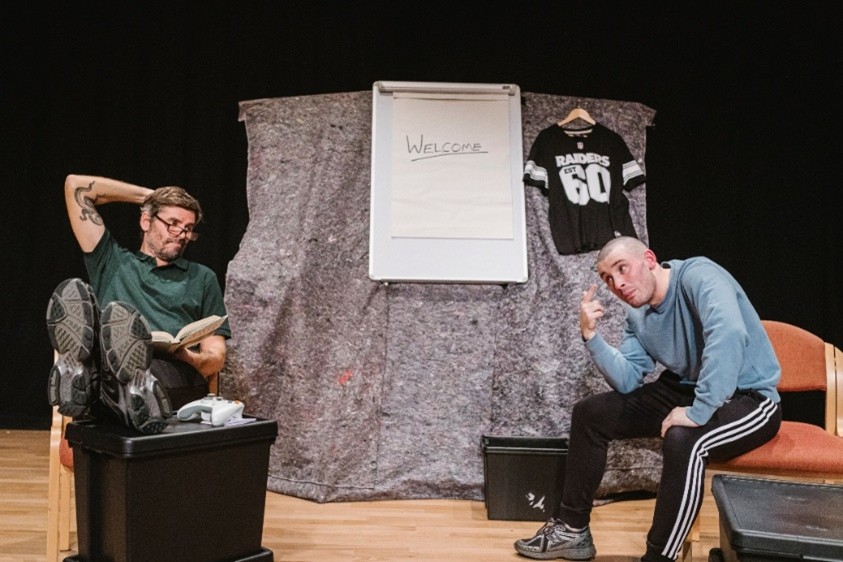
In the first presentation by Sam Rowe, he spoke about his work with Bethany Christian Trust and in his position as a community-embedded researcher with REALITIES, co-producing plays with individuals in prison. He discussed the most recent play, ‘Mind of Man’, which came out of this process and was performed at the Scottish Storytelling Centre in November 2025. It told of two individuals in prison and their experiences with and understanding of neurodiversity. Following his presentation and the discussion that followed, points were made about how rarely one hears about joy when people are in prison; the importance of supportive environments to help individuals develop skills and that even those who have committed serious offences deserve hope.
In the second presentation, Lucy Campbell talked about her work with Flip of the Coin and, as a community-embedded researcher with REALITIES, how it took multiple iterations to create the group that exists today. The initial iteration started as a group for women involved with criminal justice, but through conversations it became clear that it was important to have a community group open to anyone interested, without a label attached. This was especially critical given the small Highlands community in which Flip of the Coin is based. In the discussion that followed, there was some question about how such a programme could be scaled up and Lucy highlighted the importance of recognising small community contexts as crucial to success and understanding.
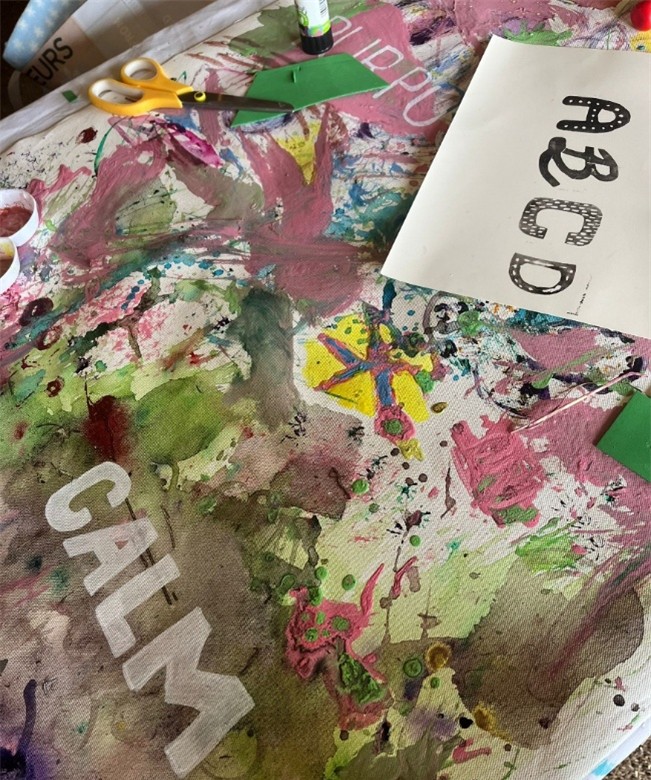
In the third presentation, Deborah McArthur discussed her role in Arts Development at North Lanarkshire Council. As a community-embedded researcher on REALITIES, her work centred on efforts to connect with the justice team to approach the legal system differently. Specifically, the initial idea arose from the intention to focus on early intervention rather than crisis management. Varying constraints relating to time and budgets led to delays in the programme starting, but in turn led to insights about the importance of relationality and how many barriers there can be to developing creative programmes in the areas of justice. In the discussion that followed, points were raised regarding how perception shapes power. For instance, when people realise the work reflects real experiences, they are often more likely to engage.
In the afternoon brainstorming session, we divided into four groups which led to more focussed discussions on the topics of: Social Work and Criminal Justice, Education and Criminal Justice, Changing Culture/Minds, and partnership between services. These discussions led to various questions being posed:
- How do we teach social work students to balance care and control better?
- How do we give school-age students the support they need?
- How do we help the public understand and support rehabilitation?
- How can the approach to partnership and community work be brought into statutory services?
Overall, the seminar offered a space and opportunity to think critically and creatively about the barriers and enablers to how the criminal justice system may be reframed. Participants mentioned that they valued the opportunity to hear about innovations in criminal justice and in various stages of progress through the REALITIES project, alongside the discussion on potential next steps.
There is a zine in progress by Lara Decastecker to showcase the seminar’s topics and discussions that will be available in the coming weeks.
Cover image: Deep Bhullar