A guest blog from Zoey Wang, a graduate of MSc Global Mental Health and Society at the University of Edinburgh.
When I first started writing my dissertation, I hadn’t anticipated how often I would find myself reflecting on the idea of a “garden” – not just as a beautiful space, but as a form of connection: between people and nature, between individuals, and between a person and themselves. Set in Scottish care homes, my research explores how horticultural interventions can support the psychological well-being of older residents and care staff, as well as the organisational and cultural factors that enable such initiatives to thrive in the long term.
Finding Meaning in the Garden
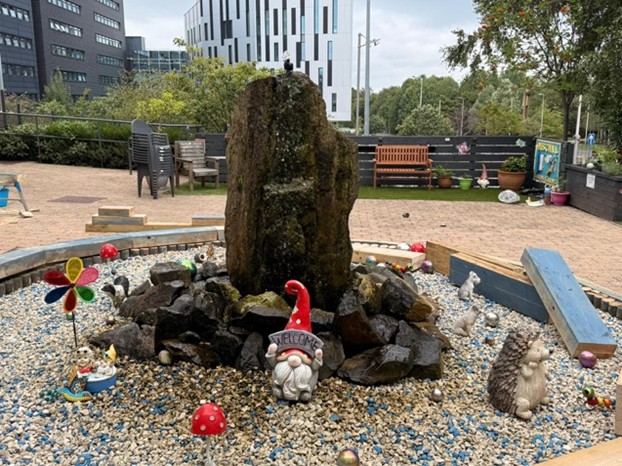
Through interviews with care home managers, care staff and horticultural therapists, I came to understand that a garden is far more than a pleasant landscape. For residents, it is a source of sensory awakening, a space for moments of freedom and calm. For carers, it offers a place to “breathe” – somewhere they can reconnect with a sense of purpose amid busyness and pressure.
One carer told me, “When the residents step into the garden, they become themselves again.” That stayed with me. It made me realise that health and well-being are not simply the absence of illness, but about being seen, understood and respected. In these natural interactions, personal identity is restored. Older people and staff are no longer just “cared for” and “carer” – they become companions, meeting as friends. The garden is the setting where this becomes possible, a place where relationships grow gentler and more meaningful.
From a socio-cultural perspective, the garden also serves as a symbol – one that reflects a shared human understanding of life, growth and care. It is not an isolated space, but one woven together by social relationships and emotional meaning. In Scottish care homes, it becomes a medium for emotional flow and a quiet form of social support.

Research Findings
My study identified two main pathways through which gardening activities support mental well-being:
- Contact with nature: through plants, sunlight and sensory experience, helping participants restore attention, reduce stress and enhance self-efficacy;
- Social interaction: through shared tasks, conversation and cooperation, strengthening teamwork and social belonging.
Crucially, these two pathways are not separate; they intertwine in the garden as a “shared space”. Moreover, people’s engagement with the garden exists on a spectrum – from light involvement to deeper immersion – allowing everyone to find their own place within it. When residents and staff care for plants together, caregiving evolves from an individual, one-way act into a collective, reciprocal practice, transforming labour into social and emotional exchange. This kind of interaction forms what might be called a “green care” model, one that is both therapeutic and social, offering new perspectives on mental health promotion in residential care.
In addition, the long-term success of gardening interventions depends on three key enabling conditions: an open organisational culture, accessible garden design, and mutual trust in relationships. When these work together, the garden becomes more than a pleasant retreat – it becomes part of the care home’s way of life.

From Research to Personal Growth
This project also reshaped my understanding of what “research” can be. It is not just about gathering data – it is about listening: to stories, emotions, and to what is left unspoken. Some interviews took place in sunny gardens, others indoors with rain against the window. Each conversation reminded me that care, like research, requires patience, empathy and trust.
At first, I saw my role as a detached, rational observer. But in the field, I came to recognise that I was also emotionally involved. Every handshake, smile and sigh quietly shifted my understanding of “happiness”. I began recording my own reactions and feelings in a research journal. This practice of reflexivity helped me see that research is not a neutral observation, it is a continuous process of mutual understanding and co-creation between people.
Conducting this research in Scotland also brought me closer to the healing power of nature. Scottish society’s deep appreciation for the natural world showed me how people and environment can nourish one another. And along the way, I found myself being healed, too – I had set out to study how gardens help others, but in the process, the gardens and people’s stories helped me.
From Personal Experience to Social Meaning
The value of horticultural interventions extends far beyond improving individual well-being. They invite us to reimagine what “care” can be – a holistic practice that integrates nature, emotion and social responsibility.
In Scotland, government and charity initiatives such as ‘Green Care’ and ‘Social Prescribing’ are gaining momentum, giving this research real-world relevance. Gardens could become bridges connecting healthcare and community, science and humanities.
Against the backdrop of global ageing populations, how can we ensure that later life is not just about survival, but about dignity and fulfilment? Horticultural interventions offer a gentle yet powerful answer. They remind us that being connected – to others, to nature, to ourselves – is at the heart of psychological well-being.

Looking Ahead
Although the dissertation has been submitted, I don’t consider the research complete. I’m still reflecting, reading, and hoping to connect with others who share these interests. The relationship between gardens and care continues to grow – every conversation, every planting, every moment of companionship adds another layer.
Looking back, I feel deeply grateful: to the participants who opened their hearts, to those who supported the project, and especially to my supervisors, Autumn Roesch-Marsh and Emma Martindale, for their guidance throughout. Research can be lonely at times, but their presence made this journey warm and luminous.
Finally, this work has taught me that knowledge, like a garden, only truly grows when it is shared. May every garden become a place where people feel understood, connected and restored.
Zoey Wang is a researcher and writer exploring the intersections of care, nature, and human connection. Her work focuses on how relational and environmental practices – such as horticultural interventions in Scottish care homes – can support well-being, restore identity and foster meaningful social relationships. Through qualitative and reflective approaches, she seeks to amplify lived experiences and highlight the subtle ways everyday spaces nurture psychological and social flourishing. She looks forward to exchanging ideas and continuing conversations with everyone. Zoey can be reached at: wzixin112@gmail.com
You can find out more about related Binks Hub work in our collaborations with Trellis Scotland.