

A blog by Dr Autumn Roesch-Marsh
On 10th November 2025, the Binks Hub ran a workshop at Moray House School of Education on the topic of working creatively with ethnic minority children. The day was developed by Dr Autumn Roesch-Marsh, Co-Director of The Binks Hub, in partnership with her former student Robina Rubin.
The afternoon began with an introduction from Dr Autumn Roesch-Marsh. She asked the workshop participants to share their interests in this work and to discuss one creative or artistic influence that had inspired them. The assembled speakers shared their own influences which included music teachers, poets, and storytelling grandmothers. The participants then had a chance to share, offering lovely reflections on a range of creative and artistic influences, and the role of key mediators like family, friends and teachers.

Autumn then gave a short overview of some of the key research in relation to working creatively with minority ethnic children. She began by discussing the changing context in Scotland, which includes a changing population:
- 1% of Scotland’s population come from a Black/minority ethnic backgrounds – an 84% increase since Scotland’s last census in 2011. 11.6% of all under 18s are now from Black/minority ethnic backgrounds (2022 Census)
- 53% of Black and minority ethnic children live in relative poverty – more than double the average rate in Scotland (Joseph Rowntree Foundation 2024)
Autumn also highlighted the fact that arts education is increasingly appreciated as having value in educational settings because of the way it can develop communication and observation skills, visual literacy and empathy. However, Black and minority ethnic children are less likely to have access to arts education (see OECD, Culture Learning Alliance, Runnymede Trust).
Autumn went on to discuss some of the key reasons why engagement with artistic and creative methods matters for all children, but especially for those from Black and minority ethnic backgrounds. This includes the way these methods can:
- increase cross-cultural sharing, especially when arts-based methods allow children and young people to share culturally rooted stories and diverse arts method (Moody and Horn 2022)
- support work around identity and belonging (Ajodhia & Cohen Miller 2024)
- support dialogue around difference, e.g. Art as Catalyst: Three Ways to Talk with Children about Race (The Art Institute of Chicago)
- support anti-racist education (Knight 2018)
- support recovery from trauma and promote resilience (Morison et al. 2022)
There was then a discussion with participants about other important benefits including joy, fun, social connection and development of self-knowledge and self-confidence.
The next speaker was Robina Rubin who spoke about her Making Up My Mind project. This was a six-week student-led outreach project conducted in 2023 with care-experienced children and adolescents in socio-economically disadvantaged neighbourhoods in Austria. The project aimed to address a gap in resources by piloting a curriculum tailored to the unique needs and strengths of care-experienced and immigrant children. Drawing on Emmy Werner’s findings (2005) that resilience can be fostered by providing children with tools to strengthen their sense of agency, and informed by Theory of Mind literature, which highlights the importance of enhancing children’s understanding of differing perspectives (Ruffman et al., 2002), the project combined creative methodologies to support social-emotional growth. Strengthening socio-emotional skills is particularly important for these children, as they are often exposed to systemic adversities. By helping them conceptualise and better understand their challenges, the project aimed to equip them with the tools to navigate these hardships and follow a path of positive development.
This project serves as a first step in addressing the lack of accessible creative methodologies designed for care-experienced and immigrant children. By reflecting on the outcomes and the children’s creative contributions, the project offers insights into the potential of arts-based approaches to support resilience and empathy in marginalised youth.

The third presentation was by Dr Kristina Konstantoni, Iffah Humaira Eri Tantawil and Reyhaneh Mozaffar. Together they spoke about The Play Café Project funded by the Froebel Trust. In their presentation they explored how co-led research with young children is an emerging field of research, yet there is a gap in how it can be understood in different geo-political and cultural-economic contexts. Drawing on their study, which took place in Scotland and Greece across a period of two years, the presentation shared creative ways of co-led and co-created research with very young children (from birth up to 8 years old).
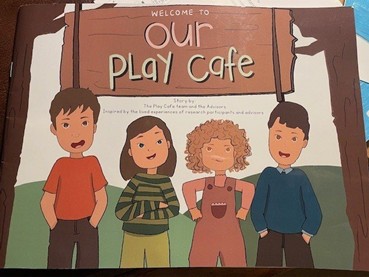
The play café project explored young children’s and their families’ experiences of play and public life, and together researchers co-designed with children their ideal play cafes. The research process involved co-creation with young children from the research idea to being-living-playing-researching-learning-sharing-doing-working together. This involved actual creations of physical play café spaces. They shared their work through photo-stories which demonstrated their process of innovation and impact, through play-based, art-based and other participatory and creative approaches, including the children’s own storybook (and the process of storybooking) which was co-created between adult researchers, children advisors and research participants, and a visual artist illustrator.
The final presentation was by Dr. Kamal D. Ibrahim. Drawing on his significant practice wisdom, Kamal spoke about his experience of working as a Social Worker supporting Black and minority ethnic children and families across various services in Edinburgh. In particular, he spoke about how the experience of disability remains a difficult subject matter amongst various groups – notably those of Black, Asian, & Other Minority Ethnic groups. For instance, many parents with children who have Additional Support Needs (ASN) can struggle to come to terms with their child’s diagnosis. The reasons for this are socio-cultural and include feelings and experiences of stigma and shame, as well as religious beliefs.
The presentation focused on three key thematic areas: working with inter-cultural perspectives on disability; identity, connection and representation; and poverty and its impact on parental mental health. For parents from BAME backgrounds, these themes can also be heightened by racial discrimination, community stigma and socio-economic disadvantage.
Kamal shared his own use of African stories, such as that of Anansi the Spider, as a way of talking to children and parents about feelings and surfacing learning.
After a question-and-answer session participants had the opportunity to engage with three creative activities:
- A collage activity devised by Autumn, inspired by Barbadian-Scottish artist Alberta Whittle
- A poetry activity Robina used with young people that was inspired by Poetry for Wellbeing resources
- A chance to explore the Play Café story book developed by Kristina and her team.
Feedback from participants suggested that they appreciate the range of perspectives on creative methods and the diversity of presenters, and that they would try out some of the ideas suggested in the workshop.
Cover image: Vanessa Loring
References
Ajodhia, A. & A. S. CohenMiller (2024) Can arts-informed pedagogy facilitate communities of learning and belonging for minoritised early years children? An integrative review of research, International Journal of Early Years Education, 32:1, 52-67, DOI: 10.1080/09669760.2019.1685467
Hickey-Moody, A. & Horn, C. (2022) Family stories as resources for a decolonial culturally responsive pedagogy, Discourse: Studies in the Cultural Politics of Education, 43:5, 804-820, DOI: 10.1080/01596306.2022.2062834
James, S. J., & Wood, M. (2025). A country that works for all children and young people: An evidence-based approach to creating a culture of inclusive opportunity through arts and creativity. Child of the North/Centre for Young Lives. Available at: CotN_Arts-Creativity_Report_12.pdf
Knight, H. (2018) The Impact of Arts Education Programmes on Anti-Racist School Practice in the South West of England
Morison, L., Simonds, L. & Stewart, SJ (2022) Effectiveness of creative arts-based interventions for treating children and adolescents exposed to traumatic events: a systematic review of the quantitative evidence and meta-analysis, Arts & Health, 14:3, 237-262, DOI: 10.1080/17533015.2021.2009529
Ruffman, T., Slade, L., & Crowe, E. (2002). The relation between children’s and mothers’ mental state language and theory‐of‐mind understanding. Child development, 73(3), 734-751.
Werner, E. E. (2005). Resilience research: Past, present, and future. In Resilience in children, families, and communities: Linking context to practice and policy (pp. 3-11). Boston, MA: Springer US.